

Blog Post
One of the most challenging aspects of buying a home for the first time is establishing good credit. Of course, it goes without saying that to qualify for a mortgage with affordable monthly payments, you’ll need a credit score that shows lenders you’re trustworthy and responsible with money. But, when you're burdened with a lot of debt, achieving a good debt-to-income ratio can be easier said than done.
If you have multiple debts that you find yourself struggling to pay off, the debt snowball method can help you achieve your financial goals and bring you one step closer to your dream home.
Debt-to-income ratio (DTI) is a measurement of the payments you need to make each month compared to the amount of money you earn. Mortgage lenders use this number to decide whether or not lending to you will be a liability for them. Lenders typically require borrowers to have a DTI no higher than 36%.
To calculate your DTI and determine whether or not it falls into the acceptable range, use the following formula:
DTI = Total Monthly Debt Payments ÷ Total Monthly Income
Your total debt payments should include your rent (or mortgage and property taxes if you already own a home), insurance, credit card debt, and any other expenses you have to pay in a typical month, including interest. For your total monthly income, use the amount you make per month before taxes.
For example, if you pay a total of $1,500 in various debts every month and earn $5,000 a month, your DTI would be 1,500 ÷ 5,000, which equals 0.3. This would be expressed as 30%.
If this formula reveals that your DTI is 36% or higher, you will probably need to lower it to qualify for a mortgage. This is where the debt snowball method comes in.
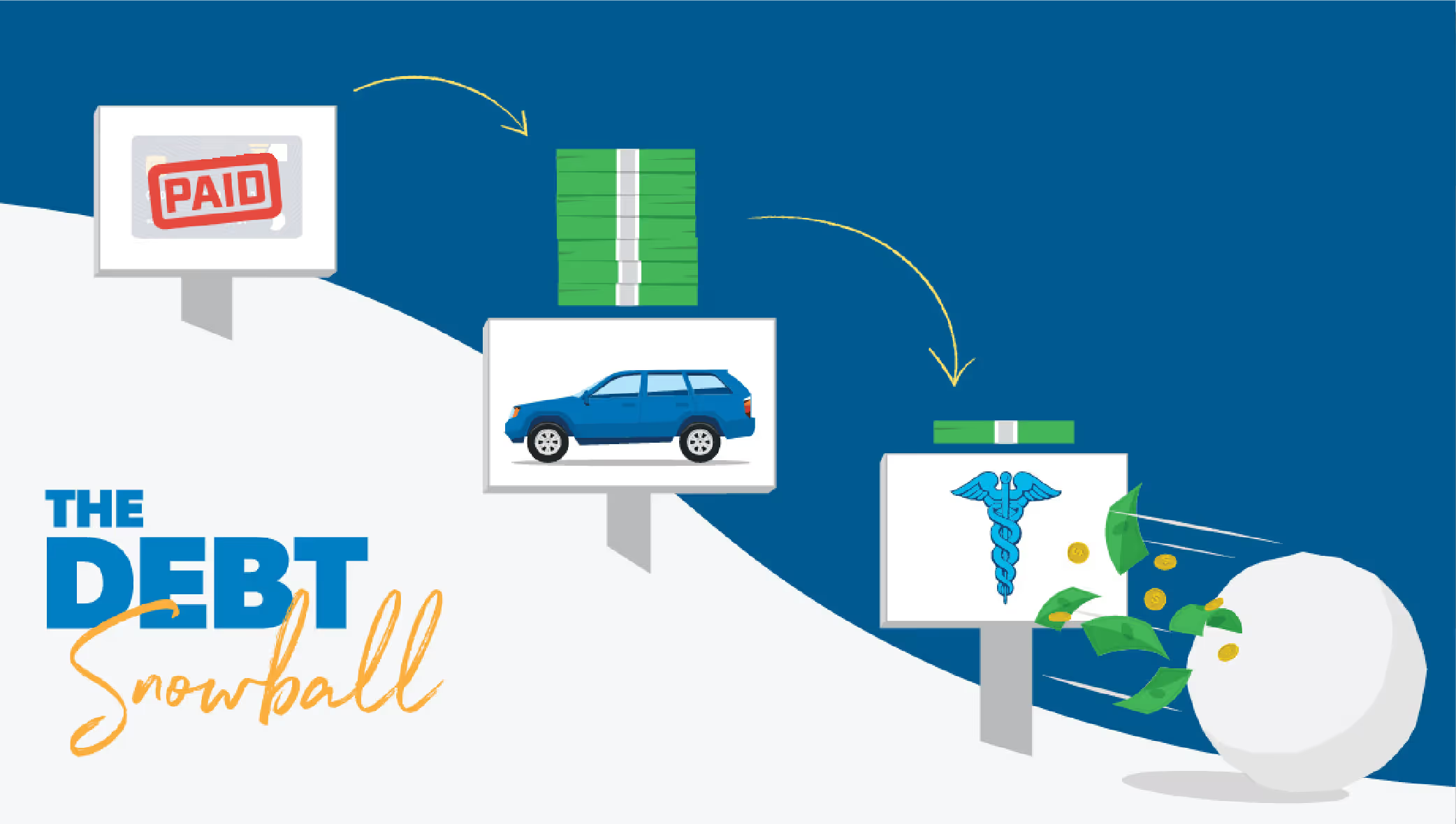
The debt snowball method is a strategy developed by businessman and radio personality Dave Ramsey to help borrowers escape from debt. Named after the way a snowball gets bigger and bigger as you keep rolling it on the ground, the main principle behind the debt snowball method is simple: momentum. The idea is that by tackling your various debts in order from smallest to largest, you can get out of debt faster than you would by paying off everything at the same rate.
The debt snowball method is more than a financial plan; it’s a philosophy that changes the way you think about money. As you pay off each debt, you’ll feel a sense of accomplishment that motivates you to get the next one paid off as soon as possible. In addition to making substantial and timely debt payments, you’ll feel less inclined to waste money on unnecessary expenses, preventing you from getting into more debt in the future.
The debt snowball method consists of four steps:
Let’s use the following situation as an example:
John is $20,000 in debt. He makes monthly payments for a student loan, a car loan, and two credit cards. He owes the following amounts on each debt:
● Credit card #1: $1,000
● Credit card #2: $2,000
● Car loan: $6,000
● Student loan: $11,000
The minimum payments John must make each month are:
● Credit card #1: $50
● Credit card #2: $50
● Car loan: $100
● Student loan: $100
This adds up to a total of $200 per month.
John also has $500 that he does not use for anything else each month.
John makes the above payments, except he pays $550 instead of $50 on credit card #1, which means that after just two months, this debt is completely gone.
With this debt out of the way, John has an extra $550 to contribute towards his new biggest loan, credit card #2, which currently has $1900 left on it. By adding this $550 to the minimum payment of $50, he pays $600 a month on this loan, meaning it will take four months to pay off completely.
Now that this debt has been eliminated, John can add $600 to his $100 monthly payment on his car loan, which is currently $5,400, for a total of $700 a month. This debt will take eight months to pay off.
Finally, the only debt John has left is his student loan, which has $9,600 left on it. By paying $700 plus $100 a month, which adds up to $800, it will take him twelve months to pay the loan off, meaning that John has gone from being $20,000 in debt to being completely debt-free in just 26 months.
If your DTI is currently too high for mortgage lenders to accept, you’re no doubt eager to reduce it as soon as possible and get yourself on the right track to buy a home. While many have achieved success in lowering their DTI by employing the debt snowball method and working their way up from small debts to larger ones, the effectiveness of this technique is reliant mainly on the borrower, and the results can vary from one individual to another.
If you’re unsure of whether or not the debt snowball method is the right way for you to build better credit, the Gaylord-Hansen Credit Resource Guide is designed to provide you with the information you need to make smarter financial decisions.
Gaylord-Hansen is committed to educating first-time homebuyers with honesty and transparency to ensure that they feel comfortable throughout every step of the home purchase process. Hear it from our customers directly:
“Great team to work with for an easy and pleasurable home buying experience...Rate was competitive and use of technology made it a painless process. I highly recommend GH mortgage.” —Juan M.
“The support and guidance we received during this whole process was very professional. They locked us in at a low rate and even with a few hurdles to overcome we closed. Thank you both for a very professional experience.” —Gary M.
“The Gaylord-Hansen team was fantastic to work with. Gave weekly video loan updates, were extremely easy to get ahold of when we had questions, and helped us every step of the way with our loan. Would highly recommend and work with them again in the future." —Katie I.
If you’re ready to start preparing for homeownership and you want to start improving your credit, download the Gaylord-Hansen Credit Resource Guide today!
Ramsey Solutions is a trademark of The Lampo Group, LLC. CrossCountry Mortgage, its subsidiaries, and affiliates have not been authorized, sponsored, or otherwise approved by Dave Ramsey or The Lampo Group, LLC.
Results not guaranteed. CrossCountry Mortgage, LLC does not provide legal, investment, accounting, or tax advice. Please consult a licensed attorney, financial planner, CPA, or tax professional on these ‘tips’ and any information or opinions contained herein.
The information contained is the viewpoint of the presenter(s). Individuals should consult their own financial representative.
CrossCountry Mortgage, LLC is not a credit repair company or credit repair organization. CrossCountry Mortgage does not guarantee improvement of your credit worthiness, credit standing, or credit capacity. Any actions you take regarding your personal finances are done at your discretion. CrossCountry Mortgage does not guarantee that you will become eligible for a loan. This is not a commitment to lend or extend credit.
.png)

.png)


